

GEURS 2026 | Ranking movements under scrutiny: how rising employer expectations are reshaping employability

Fifteen years after its first edition, the Global Employability University Ranking and Survey (GEURS) reveals a shift that goes beyond institutional positions. What is changing today is the very definition of employability in the eyes of recruiters.
Across industries and regions, recruiters are reassessing what truly matters: the weight of skills and work experience, the growing importance of international exposure, the role of academic performance, and the value of impact and leadership. As some drivers gain strength and others lose influence, the employability market appears to be entering a more mature phase, one where performance is evaluated across multiple, complementary dimensions that originate in the market’s own signals.
In 2026, more than 12,350 corporate managers from 32 countries cast nearly 120,000 votes, providing a clear vantage point to examine these shifts. GEURS 2026 captures a system in transition, shaped by skills, adaptability, internationality, and demonstrable outcomes.
From reputation to proof
In 2026, one message stands out: employers are changing their expectations.
Interactive infographic: hover to explore data
This year’s findings mark a familiar moment of transition, yet one of a different nature: employers are expressing a sharper, more professional and more demanding assessment of employability which is no longer defined by what a degree represents, but by the skills, adaptability, and real-world impact it proves. Institutions that combine strong foundations with global reach and practical outcomes are the ones moving up the ranks: proof that performance, not prestige, now sets the standard.
● Graduate skills and Work expertise stay firmly at the top, confirming that adaptability and practical experience remain the strongest signals of employability.
● Internationality continues to rise, solidifying its place in the Top 3 and confirming that global collaboration and multicultural readiness are now key hiring criteria.
● Academic performance holds a strong middle position, still valued but no longer a main differentiator in employer decisions.
● Impact & leadership is gaining ground, reflecting a growing appreciation for purpose-driven graduates and ethical leadership.
● Specialization has fallen sharply year after year. That drop signals a clear employer shift away from narrow, single-track majors toward adaptable, cross-functional profiles. Recruiters are rewarding programs that add applied experience, data literacy and sustainability/management layers on top of domain depth. In short: depth still matters, but depth-plus-versatility now beats pure specialization.
Ranking dynamics: how the institutions evolved globally
Between 2025 and 2026, movement within the GEURS ranking was significant but balanced. 6 in 10 institutions improved their position, gaining an average of 12 places, while those that declined lost around 17. About 40% of universities stayed roughly in the same position, a sign of moderate stability, and 1 in 5 experienced major shifts of more than 20 ranks, either up or down. The data captures a fast-evolving landscape, where shifts in employer perception translate directly into institutional progress or decline. This dynamic underscores how closely employability outcomes now track universities’ real-world responsiveness to market expectations.
Employability excellence expands beyond traditional hubs
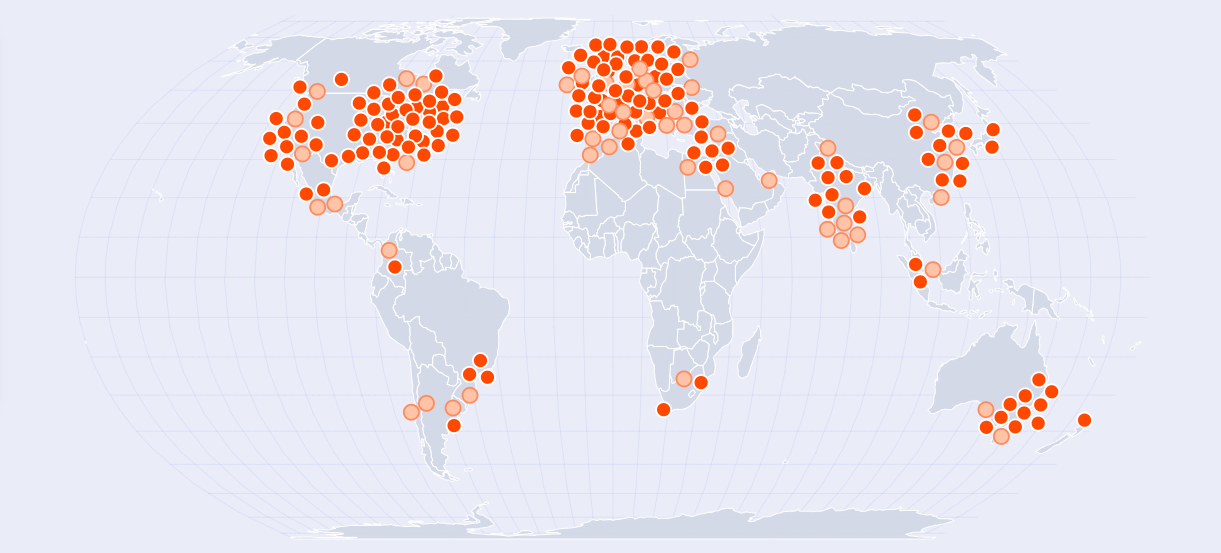
After examining how global drivers have shifted, the next layer of the GEURS 2026 story focuses on where employability strength is found, and how it’s changing across regions.
Interactive infographic: hover to explore data and use page tabs to navigate
This year definitely marks a clear turning point. The traditional English-speaking higher education systems of the United States, the United Kingdom, Canada, and Australia, are recovering after nearly a decade of relative decline in employability recognition. What once appeared to be a long downward trend, intensified by Covid, and, in the UK's case, by Brexit, is now reversing. This rebound is not cyclical but structural, driven by clearer graduate outcomes, stronger industry partnerships, and more visible evidence of workplace readiness.
Across these systems, the 2026 results send a strong signal of resilience and adaptability. Institutions in the US, UK, Canada, and Australia are being rewarded not for legacy reputation, but for their ability to demonstrate employability in practice. Systems with strong fundamentals, such as deep employer ties, flexible curricula, and international openness, are adapting quickly. If there is one standout result in 2026, it is precisely this collective comeback: these systems were written off too early
In parallel, Western Europe continues to stand out for the density and balance of its employability ecosystem. Large systems such as Germany and France remain heavyweights, while Scandinavian countries continue to impress employers through pragmatic, skills-oriented models. At the same time, Southern Europe, particularly Italy and Spain, keeps improving its position, reflecting steady reforms and growing international recognition. The result is a region where employability recognition circulates smoothly across borders.
Asia remains a central pillar of global employability, though the picture is increasingly selective. Results from China confirm that the fundamentals are strong, even if progress is not linear. Rapid growth inevitably gives way to phases of consolidation. Beyond China, other Asian systems continue to gain recognition through differentiated strategies.
Meanwhile, regions such as the Arab world and Latin America, after several years of fast gains, are entering a consolidation phase where internationality increasingly separate peers..
The outcome is not a radically new map, but a sharper one. Employability leadership is strengthening where results are clearly demonstrated, while emerging regions refine their position in a more competitive and selective global landscape.
A global race for employability leadership
Regional trends provide the broad picture, but the real story unfolds at national level. Beneath shared regional dynamics, countries are responding in distinct ways to shifting employer expectations.
Interactive infographic: hover to explore data
At the national level, this is a turnaround rather than a reshuffle. The US, UK, Canada and Australia regain confidence through employability-driven outcomes while Western Europe deepens its dense, diversified base. Asia maintains a selective core, with China stabilising after rapid ascent and Singapore setting the pace. In recent high-growth regions (parts of the Arab world) consolidation is now evident, with internationality emerging as a key differentiator.
Interactive infographic: hover to explore data
Across countries, the data reveals a pattern of broad but uneven progress. Between 2025 and 2026, over 60% of institutions improved their position, with a typical movement of around five places. Nearly 72% of total national gains are driven by just 10% of institutions, indicating that national momentum is often carried by a small group of standout universities. This dynamic is visible in countries such as the UK or Turkey, where the entry or strong rise of a limited number of institutions is enough to shift the national trajectory and signal renewed employer confidence.
At the same time, more than 40% of institutions experienced only minor rank changes, confirming that the ranking remains structurally stable while still allowing meaningful progress.
Together, these patterns point to a competitive but mature landscape, where employability leadership is open to challenge and progress is increasingly measurable.
Global patterns of national performance
The geography of employability excellence is no longer defined by a single dominant model
GEURS 2026 highlights a clear structural shift: while small systems continue to shine through a handful of elite institutions, regions such as Western Europe demonstrate that depth, consistency, and interconnected ecosystems can be equally powerful.
To capture this dynamic, GEURS introduces the National Performance Index (NPI), which measures how entire higher-education systems perform collectively within the global top 250, distinguishing between concentrated excellence and system-wide strengths.
Interactive infographic: hover to explore data and use page tabs to navigate
Western Europe and Asia account for the largest share of countries performing above the global NPI average, confirming their central role in shaping global employability standards. North America also sits above the average, though across a smaller number of countries.
When looking at average NPI scores, Western Europe, North America, and Asia converge at very similar levels of institutional competitiveness. What differentiates them is scale. Western Europe stands out with more than twice as many ranked institutions as Asia and significantly more than North America sustaining employability recognition.
Beyond these leading regions, average performance remains more modest. Latin America, the Arab World, and Central Europe show lower NPI levels, while Sub-Saharan Africa continues to face structural challenges of representation.
National models: elite concentration or system-wide strength
Interactive infographic: hover to explore data
At the country level, the contrast becomes even clearer. Smaller systems such as Singapore, Hong Kong, and New Zealand achieve very high average scores through a small number of world-class institutions.
Western Europe follows a more balanced model with countries like France or Germany demonstrating strength through a wide range of consistently performing universities.
The United States, by contrast, presents the inverse configuration. It combines exceptional presence with a wider dispersion of results.
The Global map of employability is being redrawn
GEURS 2026 shows that employability excellence is no longer a zero-sum game between elite and scale. While standout universities continue to shape global benchmarks, dense and connected ecosystems are gaining importance. In an employability market that increasingly rewards consistency, adaptability and real-world outcomes, leadership is becoming less about isolated champions and more about systems capable of sustaining performance over time and across institutions.
Conducted by Emerging and published by Times Higher Education, GEURS is the only global study based entirely on employer point of view and evaluation of graduates’ readiness for work.
This year, predictions announcing the decline of traditionally powerful higher-education systems appear, from an employability perspective, largely overstated. Canada, the United Kingdom, the United States, and Australia are reaffirming their position by shifting from prestige-based recognition to demonstrable outcomes, stronger employer alignment, and clearer graduate performance.
At the same time, European systems, particularly Germany, France, and Southern Europe, are actively reforming, while Asia continues its rise, now entering a phase of consolidation where progress naturally includes occasional setbacks. These signals are not signs of weakness, but of maturation in an increasingly competitive global landscape.
Above all, GEURS confirms the central role of employers as reliable judges of employability. Grounded in real workplace experience, their assessments have consistently anticipated structural shifts, most notably as early as 2012, when they first highlighted the growing strength of Chinese institutions. In 2026, employability leadership remains dynamic, evidence-based, and firmly rooted in measurable performance rather than inherited reputation.
-
To access tailored reports, exclusive data points, and strategic insights, contact Emerging. The full GEURS 2026 dataset provides a powerful lens to benchmark progress, identify opportunities, and understand what truly drives employer confidence worldwide.